

Counting Calories
The David Protein Bar scandal and early modern vegetarianism.

Hi there,
Sorry for the long gap in posts. We recently moved house and have been in a swirl of packing, moving, unpacking, and strategically timing the listing of our former condo with the early salvos of world war 3. The usual stuff.
But life is good! We’re settling into our new place on the other side of Oakland in a lovely, walkable neighborhood. Friends are nearby, the neighbors are delightful, and the amenities are great for a small family.
This weekend I’m racing the Oakland half-marathon. I’ve won iterations of Oakland’s half and full marathon (with friends!) in years past, but my goal on Sunday is just to finish.

A year ago, I hobbled through a few miles of the half marathon on an undiagnosed meniscus tear before dropping out; this year, my plan is to enjoy a scenic tour of the Bay’s sunny side, give high fives to people cheering, and finish healthy.
So if you happen to be in the Bay and participating in the Oakland Marathon weekend, perhaps we’ll cross paths!
Ok, now onto meatier fair!
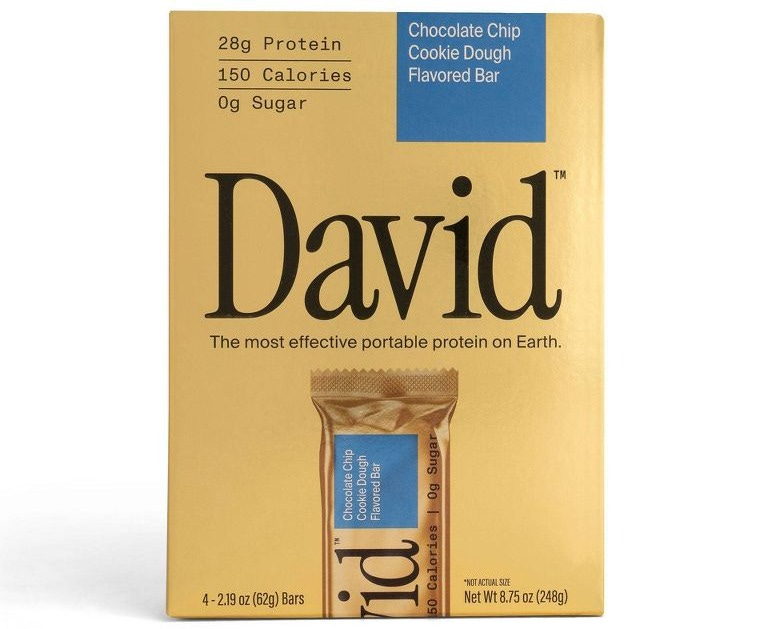
Last week, amid everything, there was a tempest in a teacup about the trendy protein bar, David.
Social media caught wind of an active class-action dispute over the popular protein bar, alleging significant under-reporting of calories and fat.
The suit, filed earlier this year in the Southern District of New York, alleges that independent testing shows the bars contain around 80% more calories and up to 400% more fat than labeled.
Social media rose to the occasion. TikTok circulated references to the movie “Mean Girls” when Regina George discovers her diet bars actually cause weight gain.

 Tiktok failed to load.
Enable 3rd party cookies or use another browser
 Tiktok failed to load.
Enable 3rd party cookies or use another browser
X users invoked the fat-free yogurt in Seinfeld, which—spoiler—turns out to have fat.

David Protein pushed back. The company, which gained popularity in 2024 from wellness influencers like Andrew Huberman and Peter Attia investing and promoting the company, contested the data behind the lawsuit.
In an open letter, company founder Peter Rahal argued the study relies on “bomb calorimetry,” a lab method that measures total released heat when food is burned. But this method is not accurate for foods with dietary fiber or fat substitutes, wrote Rahal. Supplements like David Protein Bars use ingredients that are “not fully bioavailable”—they move through the body without being fully absorbed.1
Now, as a child of the 1990s, I’m not put off by the idea of eating food that is “not fully bioavailable.” I have a long relationship with fake food wrapped in plastic. (When I die, my purgatorial penance could very well be having to eat the thousands of plastic wrappers I’ve discarded over the years.)
I like David bars. They’re easy to eat and taste pretty good. Unlike most protein bars, which are dense and clodgy, David bars are pleasantly chewable. On days I have an early commute, they let me squeeze in a workout without starving on the train ride to the office.

That said, there’s something uncanny about David protein bars. They’re surprisingly light for a bar that claims 28 grams of protein.
Also, there’s a greasy sheen that exudes from the bars’ surface. This is, I think, the manifestation of the ingredient at the center of the lawsuit: esterified propoxylated glycerol or EPG—a fat substitute David claims is undigestible. Some batches literally glisten with the stuff. So much so that a few times, I’ve needed a napkin to eat these sweatier variants.
No matter the outcome of the lawsuit, one thing is certain: when you eat a David protein bar, what you hold in your hand is less food than an artifice of science, technology, and venture capital.
That’s why there’s something reductive about the whole debate. The David bar lawsuit turns on a narrow question: does EPG’s energy “count” for human digestion the way it counts in a sealed metal cylinder? It’s a materialist and thoroughly modern view of food as mere resource or fuel. It assumes that simple measurement is the pathway to health.
Such thinking might make perfect sense for us moderns. But in other historical moments, people would hear in that dispute a much larger question: is this food an active force that continues itself inside us, and how does it shape our behavior and minds in ways we can only partly register?
My favorite historical characters I studied for my dissertation were a set of English vegetarians in the early modern period.
One of them, a hatter named Roger Crab, lived outside London and published a couple short tracts in the 1650s claiming that digestion was a literal act of re-making both body and soul. Crab turned vegetarian because eating meat not only fueled the flesh, it turned a person into fleshly matter, thick with carnal desire.

Food was never inert fuel in this view, but an entire traffic of forces by which edible matter extended itself into character, cognition, and destiny. As the vegetarian Thomas Tryon would write a couple decades later, “every sort of food has its various operations upon the body and spirit of man,” triggering emotions, feelings, and ideas within the mind.
As late as the 18th century, the English physician George Cheyne was adapting variations of these vegetarian ideas for the Newtonian age, writing popular household medical tracts that blended theories of gravity into diet advice. He argued that animal flesh’s large, salty, and cohesive particles resisted the stomach’s efforts to break them apart, resulting in thickened, glue-like blood.
There were specific religious and social issues of the time that shaped these ideas, but if the 2025 David lawsuit asks whether fat substitutes pass through harmlessly, the English vegetarians would all answer that no food ever passes through the body without effect—what you eat always continues itself in you as a new, morally fraught substance.
All that is to say, I think the notion of whether fat substitutes’ energy should or should not be measured for labeling feels thin given the richer textures through which we might consider food.
I’ll end with one last historical footnote.
The “bioavailability” of food reminds me of a scene midway through John Milton’s epic poem Paradise Lost. The angel Raphael is visiting Adam and Eve in Paradise where they sit together for a meal.

Afterwards, Adam thanks the angel for his willingness to eat lowly material food, when obviously angels must usually dine on more spiritual fare. The angel replies to the contrary: all things are derived from the same first matter and are just more or less refined and pure. Even angels can eat human food and “convert as you, to proper substance.”
Indeed, the angel Raphael insists, man might one day eat with angels and find their food not too light of fare:
“From these corporal nutriments perhaps your bodies may at last turn all to spirit, improved by tract of time, and winged ascend ethereal …”2
For early moderns, the problem was not measurement but metamorphosis. Whatever entered the body would not remain what it was. It is taken up, transfigured, and returned to the world as thought, action, desire.
No wrapper can itemize that.

The controversial ingredient in David protein bars is esterfied propoxylated glycerol (EPG), which the brand claims the body does not digest. A ConsumerLab study thinks this practice is dishonest to consumers and that EPG can potentially bind to fat-soluble vitamins.
John Milton, Paradise Lost, Book V. 491-499.
I love an essay that can pull together such disparate things as nutritional science and Paradise Lost. Well written! Almost took a Eucharistic turn. And eating wrappers would be a brutal purgative penance. Talk about not bioavailable.
Congrats on the move and getting back to the starting line. I’ve never heard of this protein bar. I’ll add it to the list of protein bars I don’t eat… which is all of them.