

And Then My Phone Buzzed
Watershed time in the age of interruptibility.

Purple tint spread across the night sky in tentative strokes.
Dawn’s first light bending morosely over the western escarpment of the Diablo Range in crumpled aubergine, running in shadows down the arroyos and barrancos of the chaparral hillsides to streambeds below.
In the dim light of dawn, the grey cities of the valley took shape heliotropic in squat and ashen blocks.

I jogged along the Guadalupe River on a bike path atop its eastern levee. As I headed toward the bay shore, the sun’s light rising over my shoulder, illustrating the environs where the alcades once ruled the pueblo and ranchos.
The river sits low in dry seasons, sluggard, stagnant, more ravine than waterway with little indication of its potential for torrents of muddy flow during the winter rains.
Rivers are a wonderful place for an ambler. Moving water tumbles along, a soothing rhythm for pedestrian tempo. I’ve run near many rivers: the Catawba, the Platte, the Seine, the Thames. They helped shape me as I grew up and entered the wider streams of the world. Smaller creeks and canals like the Mallard, the Cherry, and the Regent—tributaries to my development.
Fitting then that when I started working for a tech company, I found the only decent running near the office was upon the levees of the river bisecting Silicon Valley.
And so it was that I was running along the Guadalupe River that early morning, grateful for an hour to myself before the frenzy of the work day. Waterfowl took their first steps into the morning chill: a heron pecked through the shallows; two ducks alighted bayward; finches chirruped their welcome to the morning.
The sun continued its roll up the horizon, now casting tendrils of fire across the cloudbanks. I ran in watershed time.
And then my phone buzzed.
I ignored it. Probably some unimportant headline or coupon from Uber Eats. Then it buzzed again. And again.
Unnerved, I stopped and pulled out the phone. Was something wrong at home? Had a work crisis popped up? Had some atrocity occurred somewhere in the world?
No, none of that. Just a series of notifications, contingently timed by various product teams and news desks to land at the same time. Good Lord, I muttered, pocketing my phone and restarting my run.
One of the notifications reminded me of a work project. As I jogged, I began to ponder its facets—feedback to consider, uncertainties left to unpick. My mind drifted to other mundanities—upcoming meetings that would have pressure and conflict, incomplete tasks, dependencies that needed my input.
My brain looped and circled, spinning around this occupational trivia in a nervous short-circuit. I dwelled on them for the run’s remainder, stress seeping between my flitting thoughts. I finished in a grimace, aubergine sky and herons forgotten, mind captured by the banality of market-based concern.
The bell curve
The messages that disturbed my run are known as “push notifications,” so called because they are “pushed” from applications to users, often without the user having requested or taken action to trigger the alert.
The forerunners of today’s push notifications were the blinking lights on old landline phones and answering machines that let you know you had a voicemail. With the rise of mobile devices, those blinks turned into icons, then permuted with the advent of smartphones into elaborate notification systems.
Apple launched its Push Notification service in 2009, letting third-party apps send notifications to iPhones. A couple years later, iOS rolled out the Notification Center, allowing developers to speak to users even when apps were closed. Since then, push notifications have become richer and more pervasive, with images, action buttons, and location-based triggers.
Push notifications make my smartphone the liveliest thing I carry; they vibe and pop with haptic tactility, opening into expansive and immersive experiences. Then, curiously, having done their work, push notifications disappear. Once engaged, a push leaves no record, at least for iPhones.
Like a dagger made of ice, a push notification punctures attention and then melts away into nothing.
Interruptibility as condition for modern life
You’ve likely thought about this problem because, like me, you are inundated with notifications. According to software developer HUSPI, the average smartphone user receives around 46 push notifications a day.
Maybe you’ve read Cal Newport, or listened to Jonathan Haidt on Ezra Klein, or nodded along to August Lamm. Maybe you’ve implemented strategies for focus, meditation, and mental health. Maybe you ditched your smartphone for a Nokia brick. Or bought an actual Brick.
Most solutions are framed as personal hygiene, a matter of settings, habits, willpower, and individualistic design. My gripe is that such solutions fall almost entirely upon the individual.
I do not think push notifications are trouble in and of themselves. They are not a bad idea per se. Communication technology could save lives through public-service alerts before fast-moving disasters like tsunamis, earthquakes, or active shooters. Buzzy notifications help for ordinary, day-to-day events, like alerts that let you know your child was safely checked into preschool or to confirm receipt of an important payment.1
The problem is not notification tech itself, but our refusal to align socially on the appropriateness of when, how, and how often notifications can be sent. For now, we’ve settled on a situation in which interruptibility is a necessary condition for modern life.
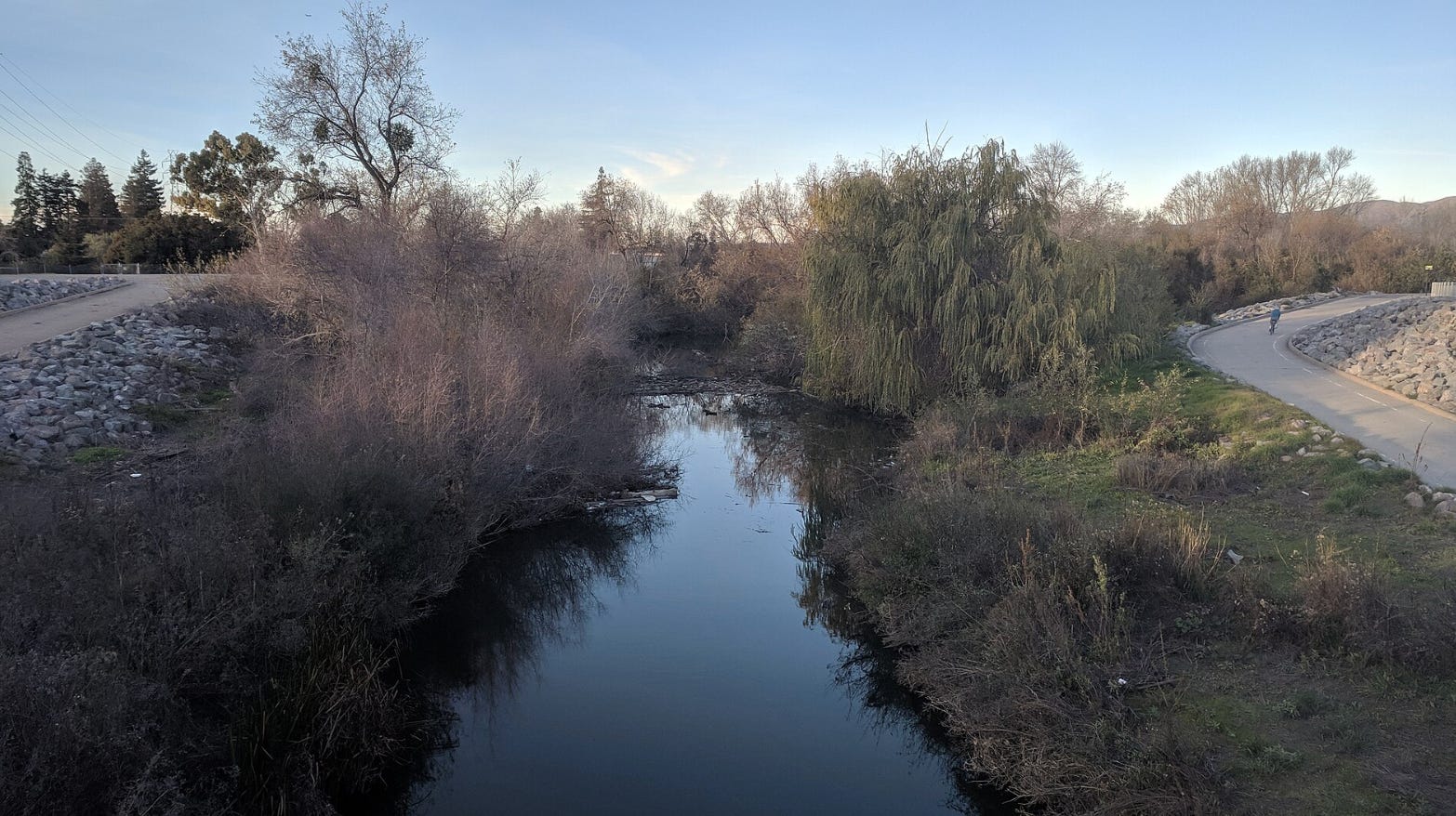

In the rainy season, the Guadalupe River sometimes floods.
Draining the entire valley, it has flooded 15 times since World War II, launching a series of flood protection projects including culverts and diversion channels. Hopefully, even 100-year floods are safely contained within the engineered system.
Like the engineered path of the river, our attention is now leveed and controlled. It is shaped, shifted, and corralled. But unlike the well-intended designs along the embankments of the Guadalupe, these levees are in service to schemes beyond our knowing and often run counter to our wellbeing.
So much for the herons and the ducks and the aubergine sky. For now, even in our most solitary moments, we risk being called back, at any moment, into some form of utility.


A few things I stumbled upon writing this
School phone-distraction policies. Laws like California’s move to limit smartphone use during class is one way governments are responding to notification overload for kids. Michigan also passed legislation requiring school districts to create action plans to keep devices away in class.
EU bans on dark patterns and manipulative interface design. The EU’s Digital Services Act explicitly bans designs that mislead or pressure people into choices they wouldn’t otherwise make.
Broader digital wellbeing work. Researchers connected to the Center for Humane Technology and similar groups argue for structural changes to attention‑grabbing tech, not just individual “self‑control” tools.
What do you think about phone notifications?


Coming up in Footnotes
An anthropology of running shoe technology. Ah, you think the carbon plate is your ally? I was born in midsole tech, molded by it. I didn’t step into AlphaFlys until I was already a man, by then it was nothing to me but an Achilles strain.
Abundance politics for endurance sport … or, does it have to take Oakland three years to build a bike lane?
Parting thought
“Solitude. Where does its value lie? For in solitude we are in the presence of mere matter (even the sky, the stars, the moon, trees in blossom), things of less value (perhaps) than a human spirit. Its value lies in the greater possibility of attention. If we could be attentive to the same degree in the presence of a human being …”
— Simone Weil, “Attention and the Will”
Such alerts already exist, although they’re most famous for false positives like the 2018 Hawaii missile alert. Imagine for a moment if that missile alert had been real. History books might have noted that lives were saved because took action based on a notification delivered right to a personal device.
Really loved this one, Sam, as much for the sentences and the words as the topic. Beautifully done 👏
I was interrupted by push notifications at least four times while reading this 🤦♂️