

The Joy of Being Serious
Chris Lear’s cult classic Running with the Buffaloes turns 25 and its portrait of Mark Wetmore’s relentless ethos still defines American distance running.

When I was young and studying at university, I spent my autumn afternoons trying to run fast in the sun. Every weekday, after classes ended, my cross-country team would assemble. Shuffling from campus lecture halls over to old Alley Gym, we’d huddle in the coach’s office for the daily briefing—team business, upcoming race logistics, and, most importantly, details of the day’s workout.
After our team meeting, we’d begin the day’s workout right as afternoon temperatures reached their apex of awfulness. Hot, wet air wrapped us like a steaming blanket as we jogged our warm-up. Sweat beaded on our skin, gathered on our shoulders and arms like rain on tropical leaves, running off us in streaming rivulets. We were dripping to death out there in the Carolina humidity.
Then the workout would begin.
“In football, you might get your bell rung, but you go in with the expectation that you might get hurt, and you hope to win and come out unscathed. As a distance runner, you know you’re going to get your bell rung.”
— Mark Wetmore
In heat or cold, collegiate cross country is always a severe sport. The training is brutal; long hours of steady running complemented by faster-paced sessions. I always dreaded interval workouts—hypoxic affairs, struggling on the edge of despair to hold on to faster teammates. A couple intervals in, my lungs would be shunting air in-out, in-out, eyes blurring as I fought to keep pace while my lizard brain screamed deargodpleasemakeitstop. We’d finish, winded, gassed, drenched shirts clinging to wheezing chests, and realize we needed to repeat the same thing again.
And that’s to say nothing of the actual racing.
If you’d like to learn more about the experience of collegiate cross country without actually dunking yourself in its miseries, there’s perhaps no better account than Chris Lear’s nonfiction Running with the Buffaloes.
The insider, day-to-day account of the University of Colorado 1998 men’s cross-country team season was published 25 years ago this April. Since then, it’s become hard to understate the book’s impact on a generation of runners.
Olympians like Evan Jager, American record holder in the steeplechase, described in an interview being “in awe of some of the things [the CU runners] were doing,” when he read the book. “I remember being really impressed with how hard they worked and some of the workouts they were doing … In the moment after reading it, it just made me want to work harder.”
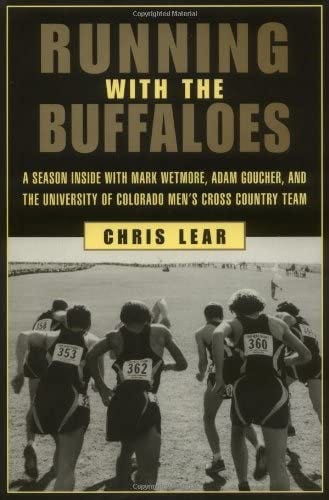
A single book can’t take credit for the resurgence of distance running in America. But there’s no doubt it galvanized a generation of Millennial runners; it was printed right as a wave of new talent, cultural energy, and institutional muscle began to build momentum in the American running scene. A quarter-century later, Running with the Buffaloes remains widely read for a book about cross country. Currently, it has a 4.6-star rating with 996 reviews on Amazon.
Lear followed in the footsteps of immersive nonfiction sports literature like H. G. Bissinger’s Friday Night Lights and The Miracle of Castel di Sangro by Joe McGinniss. He embedded himself within the Colorado cross-country team, riding his bike alongside the athletes through their workouts, traveling to their races, documenting the team’s progress and stumbles, tragedies and triumphs.
Written journal-style, each chapter is like an entry of a running log. We follow the two-dozen runners day-by-day, from their first team workout in late summer to the culmination of the season at the national collegiate championship.
The main characters are the coach and the prodigy. In 1998, Colorado head coach Mark Wetmore has built a program on the verge of national success. Will he now claim the crown at the Big Dance? Then there is Adam Goucher, the star runner and dramatic focus. He is the wunderkind now in his final collegiate season. But a national title has eluded Goucher, who enters his senior season with one last shot.
Goucher’s is the key plot line: will he take the individual title? His abilities are otherworldly: he smashes his intervals, demolishes his first race, and drops a 5:13 mile at 8,000 feet of elevation when he is 20 miles into a long run. An early season setback introduces some uncertainty in the form of a surprising loss at the national pre-season meet. Nevertheless his dominance is clear: only bad luck or injury threaten his chances.
If Goucher’s tale is a seemingly inevitable march to victory, the broader Colorado team’s story is more uncertain, exciting, and ultimately tragic. The 20-odd runners get less spotlight; what glimpses we get of their worldviews, thoughts, and anxieties are mostly revealed through the descriptions of key workouts—long runs on Magnolia Road at 8,000 elevation, searing intervals in dry Colorado sun, or threshold runs on hilly golf-course circuits.
Throughout it all, Lear’s prose clips along like a beat reporter. He’s precise and without embellishment, unfurling each workout or race without bluster about the surrounding world.
His sportswriter toolkit ends up being wielded for something else entirely when a midseason accident rocks the team to its foundations. What was supposed to be a story about an unheralded state school winning a national championship became a different drama entirely—how the entire team holds together in the face of the unimaginable and rallies to the season’s conclusion.

For me, the most interesting parts of the book concern the man at the center—the coach, Mark Wetmore. After the 1998 season, Wetmore’s program notched numerous national and individual titles. But his fame among runners is almost certainly due to the peculiar ethos illustrated in the book.
Wetmore reads as a counter-culture sensei. In Lear’s telling, his perspective is prototypically Boomer; his ideas on running are rooted in formative readings of the New Zealand coaching legend Arthur Lydiard but also, Tom Wolfe’s hippie tome The Electric Kool-Aid Acid Test. Taking Ken Kesey as his exemplar, Wetmore put aside the militaristic trappings of traditional sports programs to focus on the actual task of improvement—a low-key, no-frills approach.
Rereading, I thought of Steve Jobs, famous for his casual style, his turtleneck-and-jeans appearance, his use of soft, rounded design gradients layered atop a ruthless business model and work ethic.
There’s a short scene in Running with the Buffaloes where Wetmore and Goucher are chatting in Wetmore’s office. Lear observes the screen saver on his computer scrolling the Latin words Res Severa Verum Gaudia, a phrase the composer Gustav Mahler apparently kept on his podium when conducting, meaning “To be serious is the greatest joy.” Severity undergirds Wetmore’s grander purpose: to create a space of excellence where his athletes would “suffer as much as we can to see how good we can be, safety be damned.”
Wetmore was thinking different. And it worked. He goes on to win five men’s team titles and three women’s team titles over the next two decades.
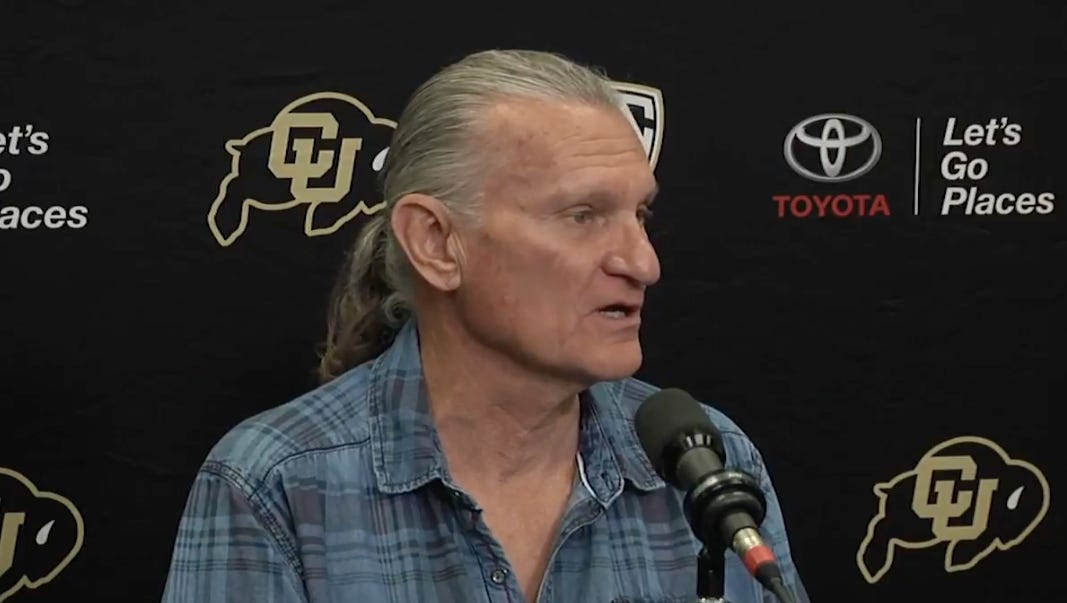
It does come at a cost: Wetmore is relentless on his athletes. While he adjusts paces and distances of his workouts based on age, fitness, and ability, the attrition rate is high in 1998. Nearly every runner on the squad experiences some degree of injury over the course of the season. The formula is successful; in 2000, the women’s team wins the national title. The next year the Colorado men win the first of five national team championships under Wetmore.
Wetmore’s time in office did not last the quarter century. He was removed as head coach last year when the University of Colorado failed to renew his contract after a 2023 report found that the CU cross-country and track program’s use of body-composition analysis “negatively impacted a significant number of student athletes” and that the program “had an unhealthy environment” for many women athletes. Multiple alumni of the program, both men and women, including Adam and Kara Goucher, have defended Wetmore from the accusations.
The report was “an inquiry review,” rather than a misconduct finding. Whether Wetmore’s departure reflected evolving standards of athlete welfare or merely sensitivity to the optics of coaching culture is unclear.
As early as the late 1990s, Wetmore placed an overt, probably unhealthy emphasis on weight. In Running with the Buffaloes, he puts an injured runner on a 2,000-calorie diet to keep him at race weight. He tells Lear, “Go look at Track and Field News. See what those people look like. You should look like a skeleton with a condom pulled over your skull.”
In the end, Wetmore’s tenure with the Buffaloes concluded in keeping with his original ethos. People suffered, excellence was achieved.
Safety be damned.

…never ran competitively but distance running has always had a romantic pull for me (took me a long time to dig in as a semi hobby)…what inspired you to get into running?…